Design Process

Design Process

Problem

The initial challenge centred on improving form accuracy and injury prevention in Pilates practice. Preliminary interviews and observation showed that users lack real-time proprioceptive feedback and often develop compensatory movement patterns.

How might we provide objective, real-time postural feedback that integrates seamlessly into Pilates practice without disrupting user flow?

Target Users

Beginner Practitioners

Ages 18-45 building correct movement patterns without constant instructor supervision.

Rehabilitation Users

Users recovering from injury who require precise movement tracking and progress monitoring.

Independent Practitioners

Intermediate users maintaining form quality during solo home practice.

User Needs

Functional Needs

  • Immediate awareness of posture deviations
  • Non-intrusive feedback that preserves flow
  • Objective progress tracking over time

Emotional Needs

  • Confidence in unsupervised practice
  • Reduced re-injury anxiety
  • Clear sense of progression

Technical Constraints

  • Must preserve tactile mat experience
  • Latency target below 100ms
  • Reliable operation across user profiles

Design Requirements

Sensing Requirements

  • 6-axis IMU tracking for spinal/pelvic alignment
  • Pressure array for weight-distribution shifts
  • Sampling >= 100Hz for dynamic movement capture

Communication Requirements

  • Bluetooth Low Energy data transmission
  • Latency budget below 80ms
  • Stable connection in studio/home range

User Interface Requirements

  • Multi-modal feedback (visual + haptic)
  • Sensitivity presets for user progression
  • Continuous-use battery target >= 4 hours

Physical Design Requirements

  • Pilates-standard surface feel and grip
  • Durable, cleanable mat materials
  • No hard protrusions from embedded hardware

Ideation & Concept Development

Multiple sensing strategies were explored through rapid prototyping. The selected architecture used hybrid sensing (IMU + pressure array), Bluetooth communication, and real-time mobile + haptic feedback.
Feature Prioritisation

Must Have (MVP)

  • Real-time posture detection + feedback
  • App visualisation and session logging
  • Bluetooth connectivity + battery management

Should Have

  • Advanced haptic correction patterns
  • Personalised user profiles
  • Guided routine presets

Could Have

  • Physiotherapy platform integrations
  • Expanded analytics dashboards
  • Companion wearable support

Won't Have (This Iteration)

  • Full ML exercise recognition
  • Cloud social features
  • Video capture integration

Prototyping

Proof-of-Concept

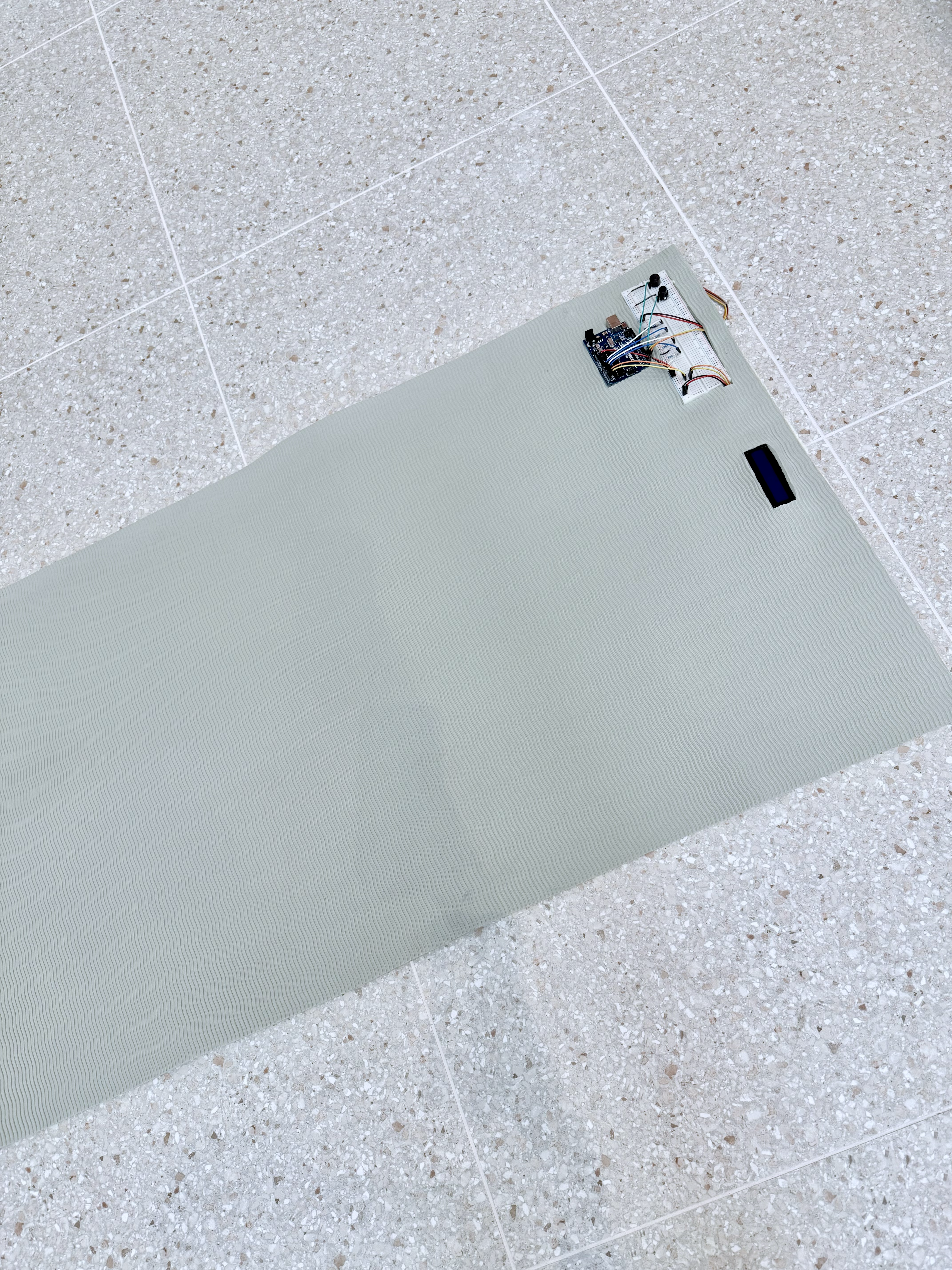
  • Arduino Nano 33 BLE for IMU integration
  • Single-sensor pelvic neutral validation
  • Initial serial visualisation pipeline

Alpha Prototype

  • Multi-sensor architecture (IMUs + FSR array)
  • BLE stack for iOS/Android companion UI
  • Embedded integration inside foam structure

Beta Prototype

  • Refined mounting for durability
  • Improved sensor-fusion drift handling
  • User-specific calibration workflow
Form Align prototyping visual

Testing & Validation

Technical Validation

IMU Accuracy: +/-1.8 degrees vs reference

BLE Reliability: 99%+ packet delivery at test range

Usability Testing

Participants: n=12 think-aloud sessions

Key Insight: calibration flow needed UX simplification

Iteration & Refinement

Hardware Iterations

  • Adjusted IMU placement for anatomical variance
  • Improved pressure hysteresis compensation

Software Iterations

  • Guided calibration routine redesign
  • Sensitivity profiles (learning/standard/advanced)

Algorithmic Refinements

  • Complementary filter tuning for noise rejection
  • Adaptive thresholding from user baseline